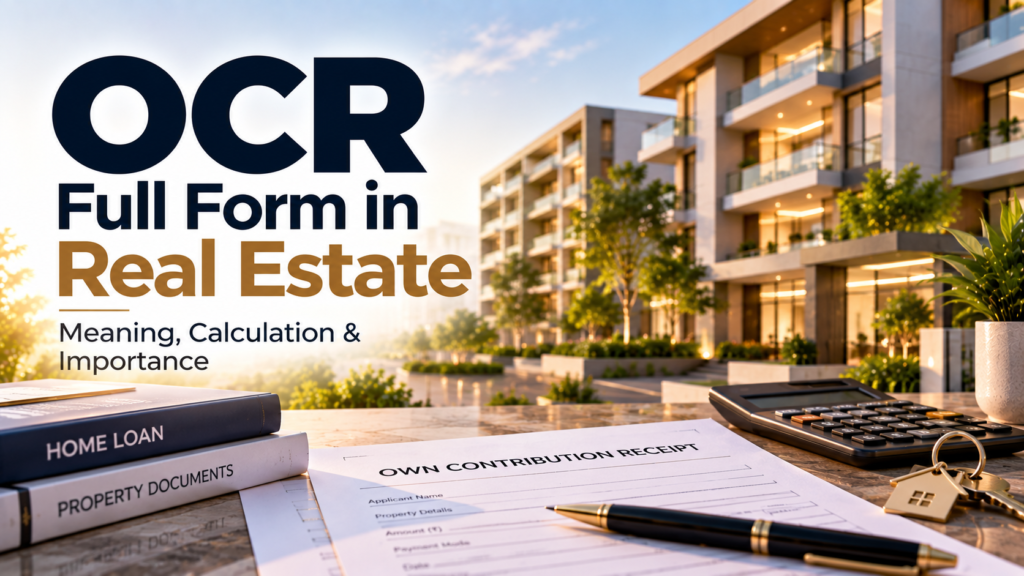

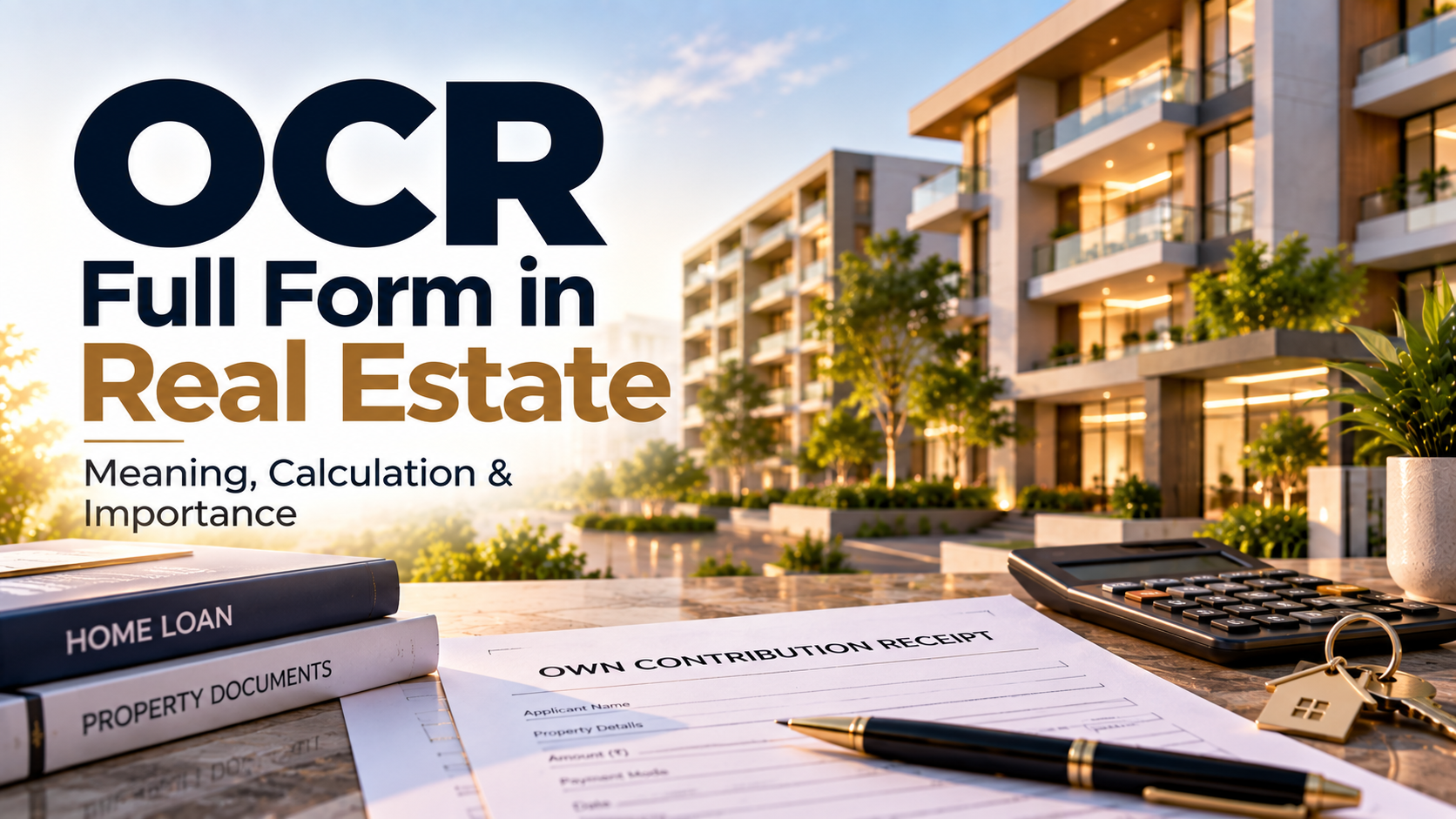
While buying your own home is an exciting thing, people who choose home loans know how hectic the entire process can get. In the loan process a term that commonly pops up is OCR full form in real estate. OCR stands for Own Contribution Receipt. It just refers to the money that you will pay yourself in the property purchase, after which the rest will be covered by the bank.
Many buyers can get confused between terms like OCR, down payment etc. Understanding all these details can make your home loan process much easier and help you keep your payment records in order.
In this blog, we will explain the OCR full form in real estate, its meaning, calculation, required documents, and how OCR is different from a down payment.
What Is OCR in Home Loan?
OCR full form in real estate is Own Contribution Receipt. In simple words, it is a receipt that shows the money a buyer has paid from their own pocket for buying a property.
When you take a home loan, the lender usually finances only a part of the property cost. The rest has to be arranged by you. This amount is called your Own Contribution. Once you make this payment to the builder or seller, you will then get a receipt for it. This receipt is known as OCR.
For example, if a property costs ₹50 lakh and your home loan is ₹40 lakh, the remaining ₹10 lakh needs to come from your own funds. The payment receipt for this amount can be used as proof of your own contribution.
The lender may ask for this proof before giving out the loan amount. OCR may also be called a Margin Money Receipt (MMR) or Margin Money (MMM) by some lenders.
Importance of Own Contribution Receipt (OCR) in Home Loan
An OCR full form in real estate is Own Contribution Receipt. Lenders ask for the OCR as proof before they release your loan amount. Here are some reasons why an OCR is important:
1. Proof of Your Payment
OCR is your proof that you have paid some amount towards buying the property from your own funds. The receipt shows the payment made to the builder or seller and helps the lender verify that your contribution has been paid.
2. Helps With Loan Disbursement
A lender can also ask you for the OCR before he gives you the loan amount. Once your own contribution receipt and other important documents are verified the lender moves ahead with releasing your funds.
3. Shows Your Financial Contribution
An OCR in home loan shows your contribution towards the property you want to buy. The lender will get a clear idea of how much you have paid and how much left you will need for a home loan.
4. Keeps Payment Records Clear
The OCR helps you keep a clear record of the payments you have made to the developer. This will be useful later on if you need to confirm the OCR amount in home loan, date or other key details of your property payment.
5. Helps Avoid Delays
The OCR is also helpful in making your loan process easier. If the lender asks for proof of your own contribution, you can submit the receipt without searching for old payment records.
How to Calculate OCR in Home Loan
Now that you know the OCR full form in real estate, calculating the OCR amount is not very difficult. You mainly need to know the total property cost and the amount that the lender is financing. The amount left after the loan amount is your own contribution towards the property.
OCR calculation in home loan formula:
Own Contribution = Property Cost − Home Loan Amount
You can also find the OCR percentage with this formula:
OCR Percentage = (Own Contribution ÷ Property Cost) × 100
For example, if the property costs ₹60 lakh and your lender approves a home loan of ₹48 lakh, you need to arrange ₹12 lakh from your own funds.
So: ₹60 lakh − ₹48 lakh = ₹12 lakh
Here, your own contribution is ₹12 lakh, which is 20% of the property cost.
Also see: IOD Full Form in Real Estate: Meaning & Approval Process
OCR Documents Required for Home Loan
When you apply for a home loan the lender will ask for your Own Contribution Receipt in home loan. Apart from this you will also need to submit other documents that will be required. Even though the exact documents needed can be different for all lenders, here is a list to give you an idea:
1. Payment Receipt
This is the main proof that you have paid your contribution. It has details like the amount you paid for the property, date and the name of the buyer.
2. Bank Statement
Your bank statement can help the lender verify that the payment was really made from your account. It will help verify the amount you have paid to the builder.
3. Cheque Copy
If you made the payment through a cheque, make sure to keep a copy of the cheque as additional payment proof to show the builder.
5. RTGS/NEFT/IMPS Proof
If the payment was made through online banking, you may need to provide the transaction slip or confirmation.
6. Demand Letter
A demand letter from the builder can show the amount requested at a particular stage of the property purchase.
7. Sale Agreement
The sale agreement provides details about the property, agreed price and payment terms. The lender may check this document along with your payment receipt for verification.
8. Payment Acknowledgement
A written acknowledgement from the builder or seller confirms that your payment has been received. It can be useful when the lender needs additional proof or clarification about a particular payment.
Common Mistakes to Avoid With Own Contribution Receipt
Even a small mistake from your end in the Own Contribution Receipt can raise questions and issues in your home loan process. You must check the OCR and other payment details before you submit them. Below are some common mistakes you should avoid:
1. Not Keeping the Receipt
Do not forget to keep a copy of the Own Contribution Receipt in home loan after making your payment. You may need it later when the lender asks for proof of your own contribution or when checking your property payment records.
2. Wrong Payment Details
Check the OCR amount in home loan, payment date, buyer name and property details mentioned on the OCR full form in real estate receipt. If any important information is incorrect, ask the builder or seller to correct it before submitting the receipt to the lender.
3. Payment Does Not Match
The amount shown on the OCR in the home loan should match your actual payment records. If the receipt shows a different amount from your bank statement or payment proof, the lender may ask for clarification before completing its checks.
4. Paying Without Proper Proof
Avoid making property payments without keeping proper payment records. Always keep the receipt, bank statement, cheque copy or transaction proof safely. These documents can help you show where your OCR amount in home loan came from.
5. Waiting Until the Last Moment
Do not wait until the final stage of the loan process to arrange your payment proof. Keep your Own Contribution in home loan and related documents ready, so you can submit them quickly whenever the lender asks for them.
Final Thoughts
Understanding OCR full form in real estate is helpful when you are taking out a home loan and paying part of the cost of the home out of your own funds. Your Own Contribution Receipt is proof of that payment and is often asked about by your lender during the loan process.
Also, keep your receipt, bank payment proof and other documents safe. Also, check the details properly before submitting so there is no confusion or delays.
Also see: LCR Full Form in Home Loan: Meaning, Purpose & Importance
FAQs
What is OCR payment?
OCR stands for Own Contribution Receipt. It is just a proof you can show to a bank that you have paid some part of the property price from your funds.
How to calculate OCR in a home loan?
You can easily calculate your OCR in home loan by subtracting the home loan amount from the total price that you have to pay for a property.
What does OCR stand for?
OCR full form in real estate is Own Contribution Receipt. It is just the money that you will pay yourself in the property purchase, after which the rest will be covered by the bank.
What happens if I cannot pay the OCR amount?
If you are unable to pay the OCR amount in home loan, then the lender will not release the loan amount from their end. Without an OCR the loan approval can either get delayed or even cancelled.
Is OCR the same as down payment?
Yes, OCR and Down Payment are basically the same things. The OCR is kind of like a proof for the down payment that you have paid for a property.
Can I take another loan to cover OCR?
Normally banks do not allow loans for an OCR, as it has to be from your own personal savings or funds.
Lok Awas is one of the most affordable premium projects in Mohali.